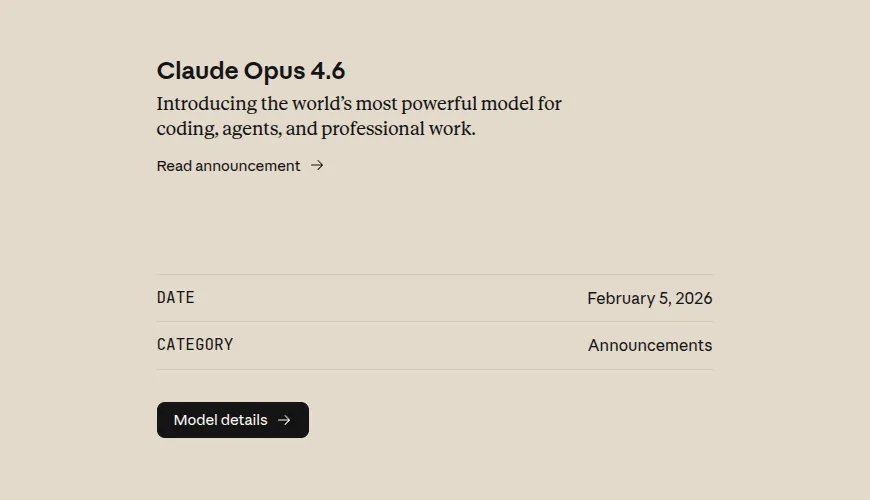

Anthropic has officially announced the release of Claude Opus 4.6, the newest version of its most capable large language model. Detailed in the official announcement, this release marks a significant step forward in how AI systems handle long-form reasoning, complex professional workflows, and autonomous task execution. Claude Opus 4.6 is positioned as a frontier model designed not just for conversation, but for sustained, high-stakes intellectual work across engineering, research, business, and analysis.
You can already try Claude Opus 4.6 in practice through CLAILA AI Chat at https://app.claila.com, where the model is available for interactive use without requiring direct API integration.
A Major Evolution of the Claude Opus Line
Claude Opus has long been Anthropic's flagship model family, aimed at users who need maximum reasoning depth and reliability rather than lightweight, fast responses. With version 4.6, Anthropic pushes this philosophy further, focusing on consistency over long sessions, improved planning, and demonstrateable gains in real-world performance.
According to Anthropic's release notes, Claude Opus 4.6 was trained and evaluated with a strong emphasis on tasks that require maintaining context across many steps. This includes reviewing large codebases, synthesizing multi-document research, analyzing long financial or legal texts, and carrying out workflows that may span hours rather than minutes. The result is a model that behaves less like a reactive chatbot and more like a persistent digital collaborator.
One Million Tokens of Context
One of the most talked-about features of Claude Opus 4.6 is its support for up to one million tokens of context in a single session. This capability, described directly by Anthropic, dramatically expands what is feasible in AI-assisted work.
A context window of this size allows the model to ingest entire books, massive technical documentation sets, or very large repositories of source code at once. Instead of breaking content into fragments and repeatedly summarizing or re-explaining earlier sections, users can ask questions, request edits, or perform analysis on the full material as a coherent whole.
In practical terms, this enables workflows such as:
- Reviewing an entire software project while preserving architectural context
- Analyzing long legal contracts without losing cross-references
- Comparing large datasets or research papers side by side
- Maintaining continuity in multi-day analytical tasks
This scale of context is especially valuable for enterprises and professionals whose work cannot be reduced to short prompts or isolated questions.
Stronger Reasoning and Self-Correction
Beyond raw context size, Claude Opus 4.6 introduces meaningful improvements in reasoning quality. Anthropic highlights that the model is better at planning multi-step solutions, detecting inconsistencies, and correcting its own mistakes during longer interactions.
In earlier generations, large language models often produced confident but flawed answers when tasks became complex or stretched over time. Claude Opus 4.6 is designed to mitigate this by sustaining internal coherence and revisiting earlier assumptions when new information emerges. This makes it particularly effective for tasks like debugging, financial modeling, and structured decision-making, where a single error can invalidate an entire result.
The Anthropic announcement emphasizes that these improvements are not just theoretical. Internal evaluations and customer feedback show that Claude Opus 4.6 completes more tasks correctly on the first attempt, reducing the need for repeated prompting or manual correction.
Agent-Style Workflows and Parallel Thinking
Another notable advance in Claude Opus 4.6 is its support for agent-style workflows, sometimes described as "agent teams.” Rather than treating every task as a single linear interaction, the model can conceptually divide work into subtasks, reason about them in parallel, and then combine the results into a cohesive output.
This approach is particularly effective in software engineering and research scenarios. For example, one agent might focus on understanding requirements, another on generating code, and another on reviewing for edge cases or security issues. While this all happens under the hood from the user's perspective, the result is faster completion and higher overall quality.
Anthropic frames this capability as a foundation for more autonomous AI systems that can handle complex objectives with minimal supervision, while still operating within clear boundaries and safety constraints.
Designed for Professional and Enterprise Use
Claude Opus 4.6 is explicitly aimed at professional users who rely on AI for serious work rather than casual experimentation. The model shows strong performance across a wide range of domains, including:
- Software development, such as generating, refactoring, and reviewing complex code
- Business and financial analysis, including interpreting long reports and building structured summaries
- Legal and compliance research, where context preservation and careful reasoning are critical
- Technical documentation, synthesis, and long-form writing
Because of its consistency over long sessions, Claude Opus 4.6 is particularly well-suited for knowledge workers who want an AI assistant that can stay "on task” throughout an entire project, not just answer isolated questions.
How Claude Opus 4.6 Fits Into the Competitive Landscape
The release of Claude Opus 4.6 comes at a time of intense competition among frontier AI models. Systems from multiple vendors are converging on similar capabilities, such as large context windows and advanced reasoning. What differentiates Claude Opus 4.6 is Anthropic's focus on reliability, interpretability, and sustained performance rather than raw speed or flashy demonstrations.
Industry commentary following the release has noted that Claude Opus 4.6 performs especially well on tasks that involve long-term coherence, such as extended coding sessions or multi-document synthesis. This positions it as a strong alternative for users who value depth and stability over rapid, short-form outputs.
Safety and Responsible Deployment
Anthropic continues to emphasize safety as a core design principle, particularly as models become more autonomous and capable. With Claude Opus 4.6, the company has expanded internal testing and monitoring to ensure that increased reasoning power does not translate into increased risk.
The model includes safeguards designed to reduce harmful outputs, limit misuse, and ensure that autonomous behaviors remain aligned with user intent. This focus is especially important in enterprise environments, where AI systems may influence real-world decisions with financial, legal, or operational consequences.
Accessing Claude Opus 4.6 Today
Claude Opus 4.6 is available through Anthropic's own platforms and selected integrations, as outlined in the official documentation. For developers, it can be accessed via API for integration into custom tools and workflows.
For users who want to experiment immediately without setup overhead, Claude Opus 4.6 is also available in CLAILA AI Chat at https://app.claila.com. This makes it easy to test the model's reasoning depth, long-context handling, and professional capabilities in real scenarios.
Why This Release Matters
Claude Opus 4.6 represents more than a routine model update. It signals a broader shift in AI development toward systems that can handle sustained intellectual work with a level of consistency that approaches human professionals. By combining massive context capacity, improved reasoning, and agent-style workflows, Anthropic is moving closer to AI that can genuinely support complex, long-term projects.
For businesses, developers, and researchers, this means AI tools that are less fragile, more predictable, and better aligned with real-world workflows. As adoption grows, models like Claude Opus 4.6 are likely to redefine expectations for what an AI assistant can reliably do.
For anyone curious to see these capabilities firsthand, the easiest way to explore them today is through CLAILA AI Chat, where Claude Opus 4.6 can be tested directly in practical, real-world use cases.